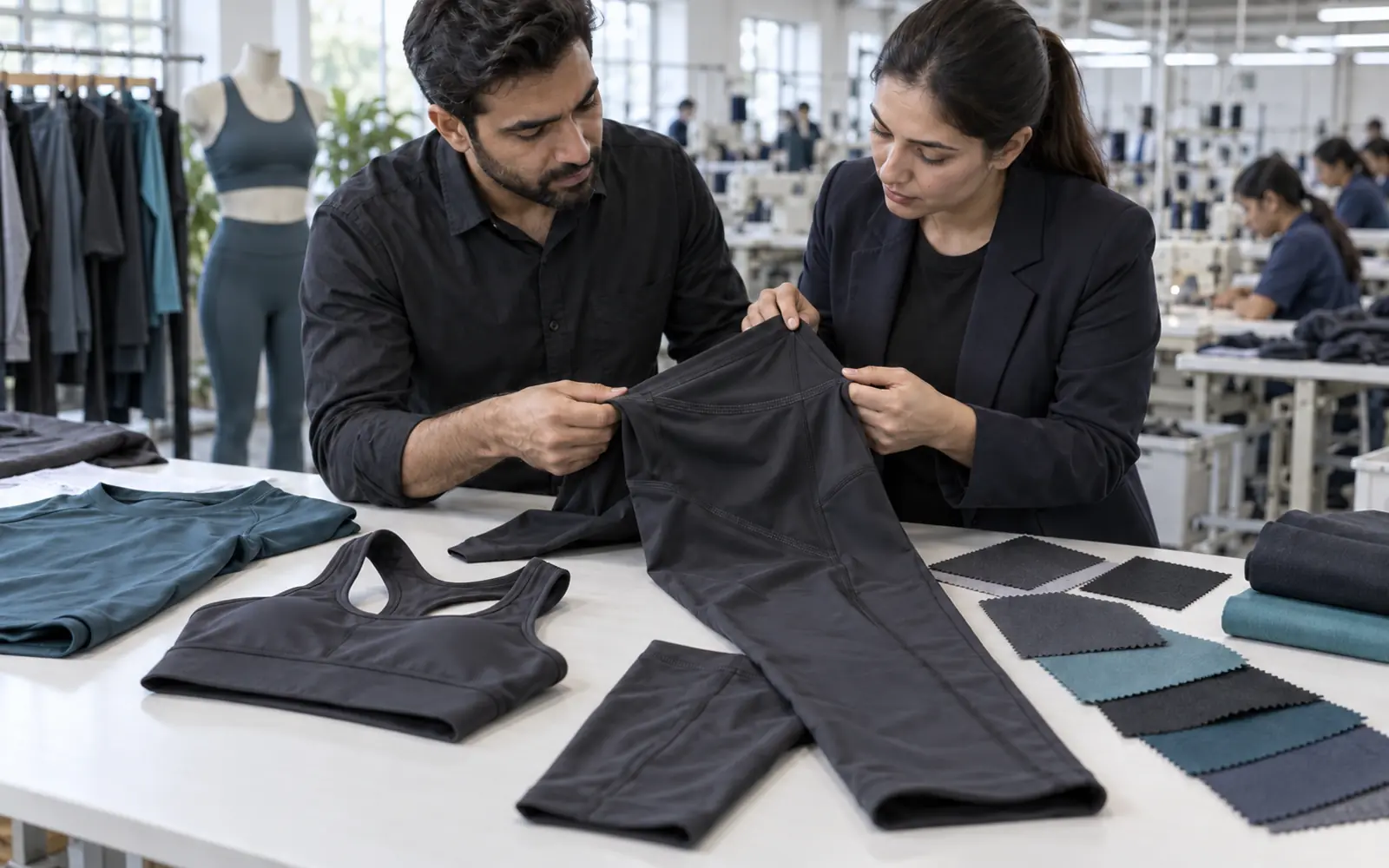
Choosing an activewear manufacturer in Pakistan should begin with product fit, not a general claim that a factory can make everything. Leggings, sports bras, training tops and performance shorts each require different fabric, pattern, seam and testing decisions. A useful supplier comparison therefore looks beyond unit price and checks whether the manufacturer can control the details that affect movement, comfort and repeatability.
Confirm activewear product experience
Ask for relevant production examples and process evidence for the exact products you plan to develop. A factory experienced in loose team jerseys may still need different pattern, stretch and seam knowledge for compression leggings or sports bras. Review the Airek Sports activewear range to define the closest starting category before requesting a quotation.
Compare fabric knowledge, not fabric names
Terms such as polyester, nylon-spandex and moisture-wicking are only starting points. The specification should also cover knit structure, approximate GSM, stretch direction, recovery, opacity, hand feel and intended decoration. Ask which tests or sample checks are appropriate for the product. Leggings may need opacity and recovery assessment, while training shirts may prioritise breathability, snag resistance and drying performance. The sportswear fabric guide explains how these variables work together.
Review fit and sampling controls
Activewear fit depends on the relationship between body measurements, garment measurements, fabric stretch and pattern ease. Confirm the base size, points of measurement, grading direction and acceptable tolerances. A physical sample should be reviewed during movement, not only laid flat. Record every approved change in one revision file so the bulk standard is clear.
Understand MOQ and landed cost
MOQ may apply by style, colourway, fabric or decoration method. Ask the manufacturer to state how the minimum is calculated and whether sizes can be mixed. Compare quotations on the same specification: fabric, GSM, branding, packaging, sample terms, production timing and shipping basis. A low unit price is not directly comparable if important components are excluded.
Check private-label capability
A private-label activewear programme may include heat-transfer neck marks, woven labels, care labels, hang tags, branded packaging and carton instructions. Confirm which items are made or applied by the factory, what artwork is required and when each proof must be approved. Airek outlines these options on its private-label manufacturing page.
Ask how quality is controlled
Before bulk approval, agree how fabric, measurements, stitching, artwork placement, colours, quantities and packing will be checked. Ask what records are retained for reorders and how a discrepancy is reported. Clear written controls are more useful than broad quality promises.
Send a comparison-ready brief
Give each shortlisted manufacturer the same product list, quantities, size range, target fabric performance, artwork, branding needs, destination and delivery target. This produces quotations that can be compared fairly. When your brief is ready, use the Airek Sports quote form to request a product-specific review.