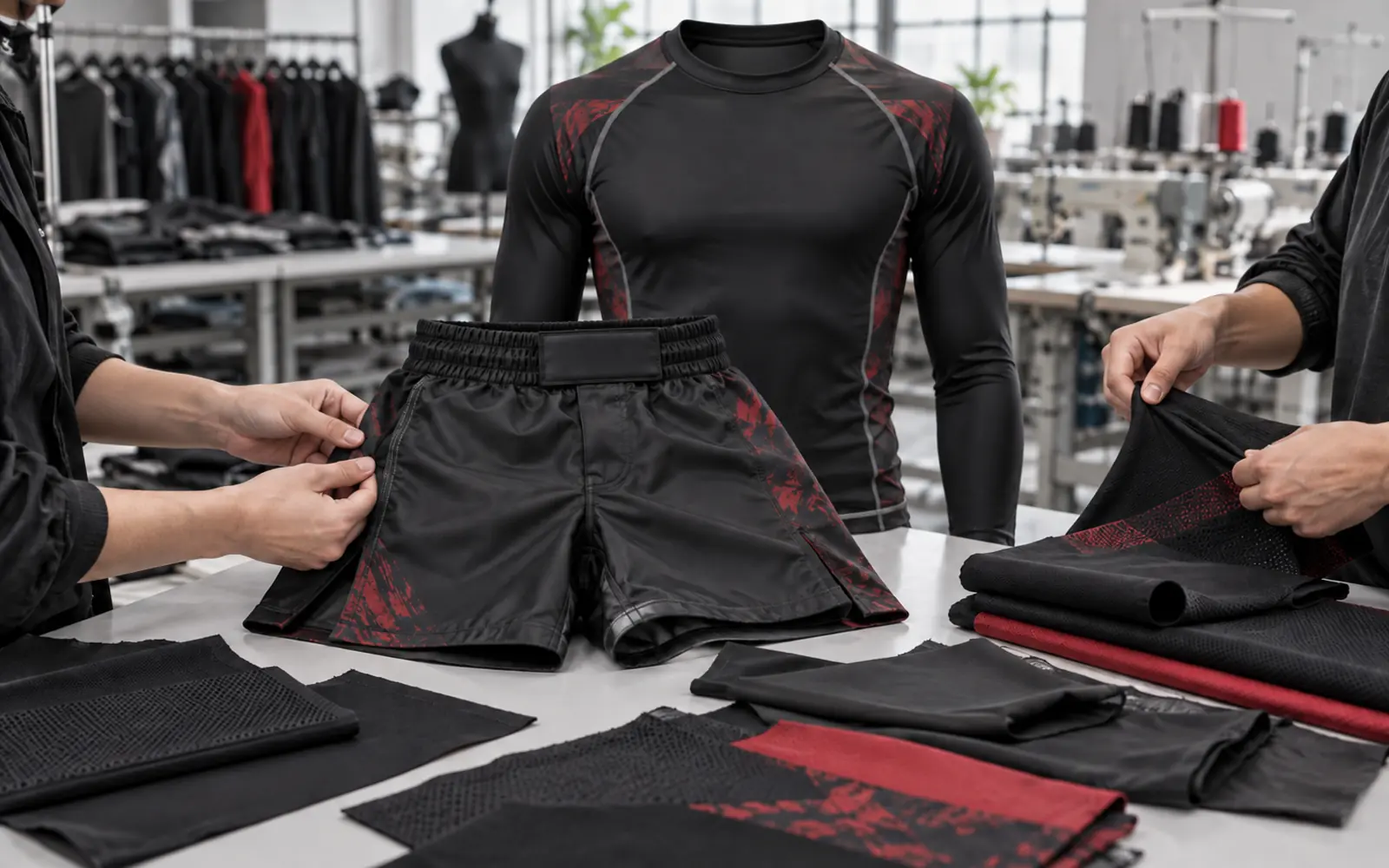
Private-label MMA clothing must handle repeated movement, abrasion, sweat and washing while presenting a consistent brand identity. Fight shorts, rash guards, compression pieces and walkout apparel should not be placed under one generic specification because each product has different material and construction requirements.
Separate the product specifications
Start with a product list and define the intended use of every style. Competition shorts, grappling rash guards, compression spats and walkout hoodies need separate measurements, fabrics and decoration plans. A manufacturer should be able to explain how the construction changes across the range.
Choose fabrics for the movement
Rash guards and compression products normally require stretch, recovery and smooth moisture-managing surfaces. MMA shorts need mobility, secure waist construction and fabric that balances strength with low weight. Confirm composition, approximate GSM, stretch direction, opacity where relevant and the compatibility of the fabric with sublimation or transfers.
Control seams and reinforcement
Review seam placement around the underarm, side body, crotch and inner leg so movement is not restricted. Flat seams may reduce bulk on close-fitting pieces, while high-stress zones may need reinforcement. Inspect stitch stretch and recovery on the actual fabric rather than approving construction from a drawing alone.
Specify waist and closure details
For fight shorts, define the waistband height, elastic, drawcord, hook-and-loop components and any side split or stretch panel. Closures should be positioned so they remain secure without creating unnecessary bulk. For compression bottoms, test waistband recovery and slippage during movement.
Match decoration to the garment
Full sublimation works well for compatible polyester-based products because artwork becomes part of the fabric. Small heat transfers or embroidery may suit other items, but heavy decoration can restrict stretch or create discomfort. Approve artwork size, placement and colour on a product-specific mockup.
Build the private-label system
Coordinate neck branding, size and care information, woven labels, hang tags and packaging with the garment approvals. Care wording and fibre information should reflect the actual materials and destination-market requirements. Review the private-label packaging guide before confirming artwork.
How to assess a custom rash guard manufacturer in Pakistan
Ask for product-specific evidence rather than general sportswear samples. A capable custom rash guard manufacturer in Pakistan should explain stretch direction, recovery, panel construction, flat-seam options, sublimation compatibility and how the sample will be tested during grappling movement. Confirm which processes are completed in-house and keep the approved fabric, pattern and artwork as the bulk-production standard.
BJJ rashguard sizing and fit checks
BJJ rashguard sizing should control chest, waist, body length, sleeve length, biceps opening, neck opening and hem grip. Confirm whether measurements are taken relaxed or stretched and test representative sizes on the intended customer body type. The garment should remain close to the body without restricting shoulder rotation or riding up during movement.
Test before bulk production
Evaluate fit through grappling-style movement, seam comfort, stretch recovery, colour, print alignment and wash behaviour. Keep the approved sample and measurement specification as the bulk reference. Browse Airek Sports MMA wear or submit an MMA product brief through the quote form.