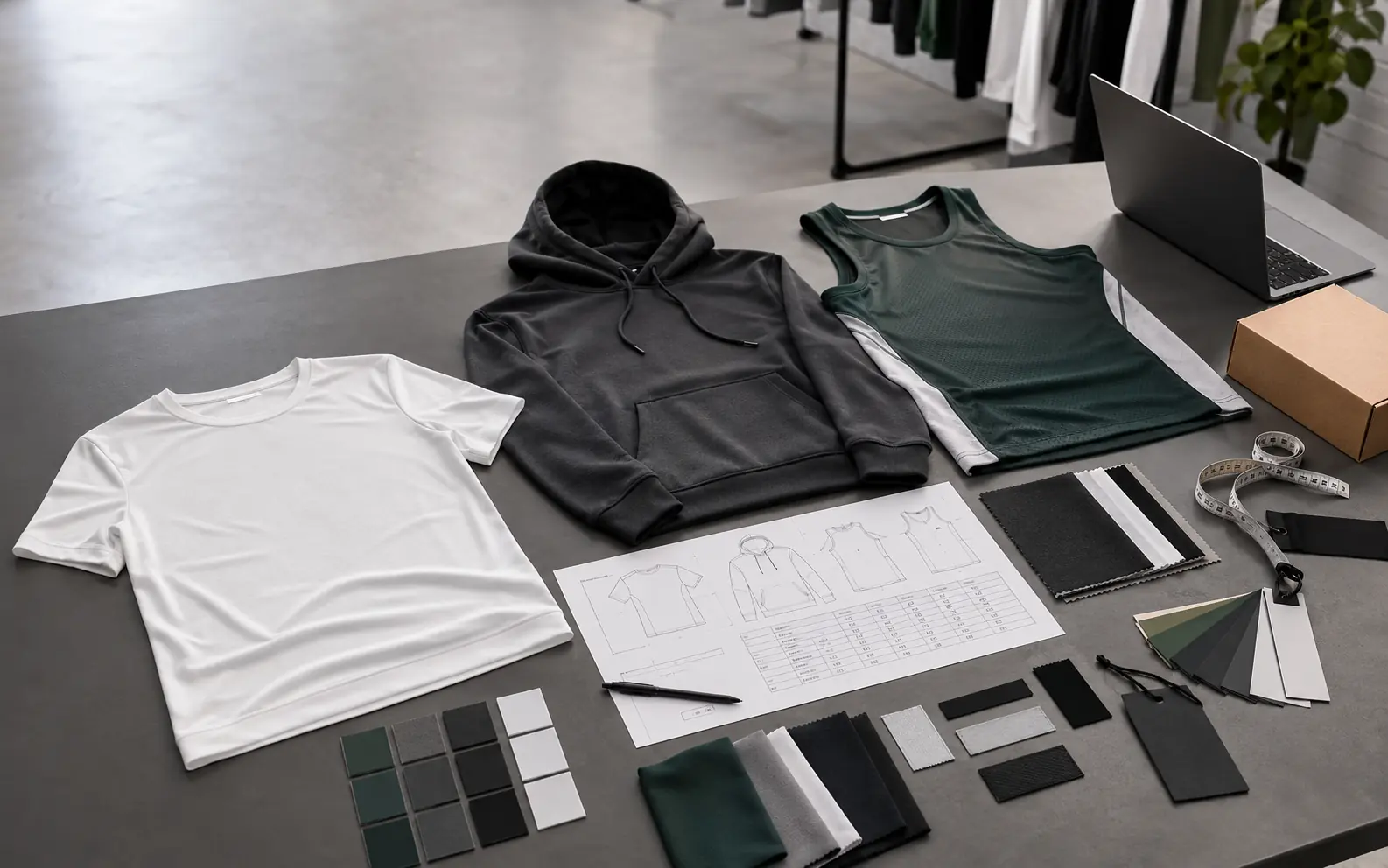
A new clothing brand can reduce risk by launching a focused collection with clear specifications. Too many styles, colours and custom components in the first order can make sampling, costing and stock management unnecessarily difficult.
Define the customer and product
Write a short description of the target customer, selling market, activity, expected retail price and product problem you want to solve. Select a small number of products that belong together.
Build the design brief
Prepare front and back drawings, reference images, logo files, colour direction, fit intention and size range. Identify what is essential and where you are open to manufacturer recommendations.
Choose materials realistically
Explain the required hand feel, performance and approximate weight. Stock-supported fabrics and shared materials across products can make a first collection easier to manage than multiple custom-developed fabrics.
Plan quantities and colourways
MOQ normally applies by style, design or colourway. Concentrating demand into fewer colourways can improve production efficiency and simplify inventory. Include size quantities when requesting a quote.
Budget for development
Plan for sampling, revisions, labels, packaging, bulk production, shipping, duties, photography and marketing. Product cost alone is not the full launch cost.
Approve branding and compliance
Confirm brand labels, care information, fibre composition, packaging and destination-market requirements. Use only artwork and names that you are authorised to reproduce.
Create a launch timeline
Work backwards from the desired delivery date. Include design finalisation, quotation, sample production, review, bulk approval, manufacturing, inspection and shipping.
Explore the startup and private-label pathway or use the project quote form when your first brief is ready.